.png)

When a Robot Didn’t Shake My Hand: What Robbie Taught Me About the Future of Human-Robot Interaction
Updated: Aug 22
By SUSTAINEVOLVE, AI Transformation Series | Intelligent Automation & Customer Experience Strategy | 2026
A Handshake That Never Happened
When I walked into the Bloque Summit in Querétaro, I wasn't expecting my first memorable interaction to be with a robot.
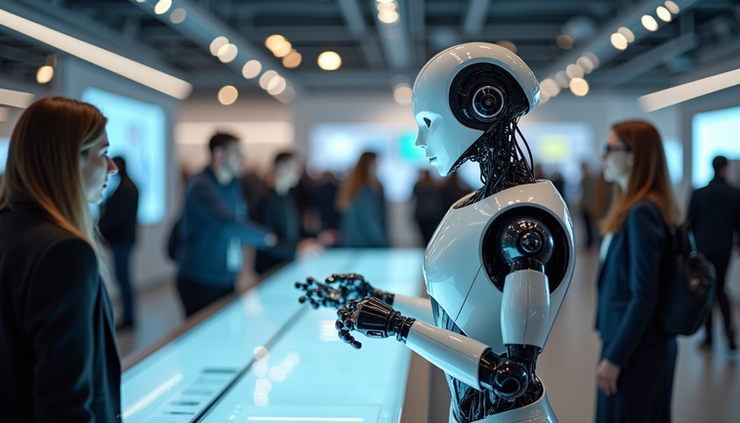
His name was Robbie.
He was moving around the conference, greeting people, observing the environment, and attracting attention wherever he went.
At first, I simply watched him.
There was something almost familiar about his behavior. He looked more like a teenage robot, young, energetic, curious, running around the space and seemingly interested in the people around him.
That curiosity was contagious.
So I decided to interact.
When Robbie came closer to me, I instinctively reached out my hand for a handshake.
He didn't respond.
For a moment, I wasn't quite sure what to do.
I laughed a little.
And, honestly, it felt a bit off.
Not because Robbie wasn't impressive. He was.
Not because I expected him to be a human.
But because I was expecting an interaction.
I had unconsciously brought my human expectations into an interaction with a machine.
A handshake is such a simple gesture. We don't think about the complexity behind it. When someone reaches out their hand, we immediately understand what it means.
Hello.
Nice to meet you.
I'm engaging with you.
We're interacting.
Robbie didn't understand that moment in the way I expected him to.
And that tiny experience made me think about a much bigger question:
How close are we really to creating robots that can interact with humans in a truly natural way?
Robbie the young robot, who did not give me a handshake
From an Expected Handshake to Physical AI
That moment changed how I looked at the robot for the rest of the conference.
Instead of asking, "How impressive is this robot?", I started asking:
"What is this robot actually capable of doing today?"
And that is where the conversation around robotics becomes much more interesting.
For years, we've experienced AI primarily through screens.
ChatGPT answers questions.
Virtual assistants respond to voice commands.
Recommendation engines predict what we might want.
Automation systems move information between applications.
But physical AI takes intelligence out of the screen and puts it into the physical world.
Now AI can exist inside machines that move through spaces, perceive their surroundings, interact with objects, and engage with people.
That changes the customer experience equation.
A chatbot can tell you where the conference room is.
A physical robot can see you, approach you, speak to you, point toward the room, and potentially guide you there.
The difference is presence.
And presence matters.
How Robotics Changed My View of Customer Interaction
At first, I was skeptical. Could a machine really enhance the way customers feel valued and understood? The robot’s role was simple: welcome guests, provide directions, and answer basic questions. Yet, the impact was immediate. Attendees were drawn to the robot, curious and engaged. It broke the ice and made the environment more inviting.
This experience revealed a key insight: physical AI can create memorable, positive moments that digital AI alone cannot. While chatbots and virtual assistants handle many tasks online, a physical robot adds a layer of presence and tangibility that changes the dynamic.

What I Learned in Querétaro
One of the most interesting things I discovered at the summit was that many current customer-facing robotics applications are still relatively focused.
Robots are being used—or explored—for things like:
Greeting visitors
Providing directions
Answering basic questions
Creating engagement
Supporting events
Assisting with navigation
Performing repetitive tasks
Exploring hospitality and retail experiences
These are useful applications.
But they also reveal something important about where we are in the evolution of physical AI.
We can build robots that move.
We can build robots that see.
We can build robots that hear.
We can build robots that respond.
We are increasingly able to build robots that learn.
But responding isn't the same as understanding a human interaction.
And that is where things get really interesting. The Role of Physical AI in Customer Experience
Physical AI refers to robots and machines that interact with the physical world and people in real time. Unlike digital AI, which operates behind screens, physical AI offers:
Tangible interaction: Customers can see, hear, and sometimes touch the robot.
Immediate assistance: Robots can guide visitors, answer questions, or even perform simple tasks.
Consistent service: Robots provide reliable, unbiased help without fatigue.
In Mexico and across the world, businesses are experimenting with robots in retail, hospitality, and events. For example, a local hotel uses a robot concierge to help guests check in and find amenities. This reduces wait times and adds a futuristic touch to the stay.
Challenges and Lessons from Querétaro’s Robotics Experience
Introducing robots into customer-facing roles is not without hurdles. The conference highlighted several challenges:
Technical limitations: Robots still struggle with complex conversations or unexpected requests.
Human comfort: Some customers feel uneasy interacting with machines, especially older adults.
Integration: Robots must work alongside human staff smoothly, not replace them.
The key lesson is that robots should complement human workers, not compete with them. In Querétaro, the best results came when robots handled routine tasks, freeing staff to focus on personalized service.

What This Means for the Future of Customer Experience
The Querétaro experience points to a future where customer service blends digital and physical AI. Here’s what businesses can expect:
More engaging environments: Robots can create interactive spaces that attract and retain customers.
Faster service: Automated assistance reduces wait times and improves efficiency.
Data-driven personalization: Robots can collect data to tailor experiences without being intrusive.
For example, imagine a retail store where a robot greets you by name, remembers your preferences, and guides you to products you might like. This level of service builds loyalty and satisfaction.
Practical Steps for Businesses Interested in Physical AI
If you’re considering robotics for your customer experience, start small:
Identify repetitive tasks that robots can handle.
Train staff to work alongside robots comfortably.
Gather customer feedback to refine robot interactions.
Choose robots designed for your specific environment and audience.
Querétaro’s robotics showcase demonstrated that success comes from thoughtful integration, not just technology adoption.
The Difference Between Intelligence and Social Intelligence
My failed handshake made me think about the difference between artificial intelligence and something I would call artificial social intelligence.
Humans are constantly interpreting one another.
We notice facial expressions.
We read body language.
We understand personal space.
We recognize when someone is uncomfortable.
We know when someone is in a hurry.
We understand that a handshake means something different from a wave.
We know when to approach someone and when to give them space.
Most of this happens without us consciously thinking about it.
It's part of our social etiquette.
For a robot, none of this is necessarily intuitive.
It has to be learned, modeled, trained, or programmed.
And that is a much harder problem than simply answering a question.
What Would a Truly Human Interaction Look Like?
Imagine going back to that moment with Robbie.
I approach him.
He notices that I'm looking at him.
He recognizes that I'm intentionally engaging.
I extend my hand.
He understands the gesture.
He responds appropriately.
But imagine that he does more.
Perhaps he says hello.
Perhaps he recognizes that I'm attending the conference.
Perhaps he notices that I'm curious about him and asks if I'd like to learn what he can do.
Maybe I ask a question.
He answers.
Then he notices that I seem interested and continues the conversation.
Now something different is happening.
The robot isn't simply executing a command.
It's interpreting context.
That, to me, is the real frontier of physical AI.
Not simply creating machines that can perform tasks, but creating machines that can understand the social context surrounding those tasks.

Examples of Robots Moving Us Toward the Future
The robotics industry is moving quickly, but not all robots are trying to solve the same problem.
Some are being designed for factories. Others are focused on logistics, research, mobility, or eventually more general-purpose interaction with people.
What they have in common is a shift from robots that simply follow programmed instructions toward machines that can perceive, learn, move, and adapt to the physical world.
Here are a few of the robots I find particularly interesting.
Tesla Optimus: The General-Purpose Vision
Tesla is developing Optimus around the idea of a general-purpose humanoid robot that could perform tasks in environments designed for humans.
Its development involves many of the fundamental challenges of physical AI: balance, walking, perception, navigation, manipulation, and interacting with objects in the real world.
The interesting part isn't simply that Optimus looks human.
It's the possibility of having a machine that could eventually perform many different physical tasks without requiring a completely different robot for each one.
Potential applications include manufacturing, logistics, repetitive physical work, and eventually service environments.
Figure: Bringing AI Into Physical Work
Figure AI is taking another major step toward general-purpose humanoid robotics.
Its robots combine vision, language, movement, balance, and manipulation, with AI systems increasingly helping the robot understand what is happening around it and decide how to act.
That combination is important.
The robot isn't simply being told exactly where to move its arm. The larger ambition is for AI to help it understand a task and determine how to complete it.
Potential applications include manufacturing, warehouses, logistics, and eventually human-robot collaboration.
Unitree G1: Mobility and Experimentation
Unitree Robotics has developed the G1 humanoid robot, which demonstrates impressive mobility, balance, perception, and manipulation in a relatively compact platform.
What makes robots like the G1 interesting is their role in experimentation.
They give researchers, developers, educators, and businesses a platform for exploring what happens when AI gets a physical body.
Potential applications include robotics research, education, development, physical AI experimentation, and future service applications.
Agility Robotics Digit: Solving a Real Business Problem
Agility Robotics is taking a more focused approach with Digit.
Rather than positioning the robot primarily as a futuristic general-purpose assistant, Agility has focused heavily on logistics and industrial environments.
Digit is designed to move through human-oriented spaces and perform repetitive material-handling tasks, such as moving totes in warehouse operations.
This approach highlights an important lesson for businesses:
You don't need a robot that can do everything to create value.
Sometimes the best application is simply solving one difficult, repetitive problem extremely well.
From Human-Looking to Human-Centered
This distinction matters.
We sometimes assume that the more human a robot looks, the more human the interaction will feel.
I'm not convinced.
A robot doesn't necessarily need a human face to provide a great customer experience.
It needs to understand what the customer is trying to accomplish.
It needs to know when to help.
It needs to know when not to interrupt.
It needs to communicate clearly.
It needs to recognize uncertainty.
It needs to recover gracefully when something goes wrong.
And perhaps most importantly, it needs to understand the boundaries of its role.
Human-centered doesn't necessarily mean human-looking.
It means designing technology around the way humans actually behave.

The Customer Experience Opportunity
This is where I believe physical AI becomes particularly interesting for businesses.
The question shouldn't be:
"Should we get a robot?"
The better question is:
"Where could physical AI make the customer experience meaningfully better?"
Consider a hotel.
A robot could greet guests, provide directions, answer frequently asked questions, or help them find amenities.
But what happens when a guest is frustrated because their room isn't ready?
That's where a human might still be essential.
Consider retail.
A robot could help customers locate products, provide basic information, or navigate a large store.
But what happens when a customer needs advice about a complex purchase?
Again, the human becomes valuable.
This suggests a much more interesting model:
The robot handles the predictable.The human handles the personal.
And AI becomes the layer connecting the two.
Robots Shouldn't Replace the Human Touch
My experience with Robbie reinforced something I strongly believe about AI transformation:
The goal shouldn't be to remove humanity from the customer experience.
It should be to use technology to make human interaction more valuable.
Robots can take on repetitive tasks.
They can provide consistent information.
They can reduce waiting times.
They can operate continuously.
They can help employees focus on higher-value activities.
But humans bring something that is still extremely difficult to replicate:
Empathy.
Judgment.
Creativity.
Emotional intelligence.
Trust.
Spontaneity.
Connection.
Those qualities become even more valuable as machines become more capable.

The Future May Be More Human, Not Less
This is perhaps the biggest paradox of physical AI.
As robots become more capable, we may actually become more aware of what makes human interaction special.
That handshake I tried to give Robbie was insignificant from a technical perspective.
But from a human perspective, it represented an expectation.
I wasn't asking the robot to perform some complicated task.
I was simply trying to connect.
And when the robot didn't respond, I immediately noticed the difference.
That moment reminded me that human interaction isn't only about functionality.
It's about meaning.

Where Do We Go From Here?
I left the Bloque Summit in Querétaro thinking less about whether robots will replace humans and more about how humans and robots will learn to work together.
We're still early.
Robots are learning how to navigate our environments.
AI systems are learning how to interpret physical spaces.
Humanoid robots are becoming more capable of manipulating objects and performing complex tasks.
And researchers and companies are working toward increasingly natural interaction.
But there is still a significant distance between a robot that can perform a task and a robot that can understand a human moment.
And perhaps that's exactly where the opportunity is.
The next wave of physical AI won't just be about what robots can do.
It will be about how they interact with us while doing it.
Can they understand context?
Can they read social cues?
Can they respect boundaries?
Can they recover from mistakes?
Can they make an interaction feel natural without pretending to be human?
Those are the questions that will define the next generation of customer experience.
From Robbie to the Innovation Lab
My interaction with Robbie started with a handshake that never happened.
But it ended with a much bigger realization.
We don't need robots to become human.
We need to become much better at designing human-robot interactions.
That means asking not only what technology can accomplish, but what experience we want people to have.
At SUSTAINEVOLVE, this is the kind of question we're exploring through our work in AI transformation, intelligent automation, customer experience, and emerging technologies.
Our Innovation Lab is a space to explore what is possible—and, more importantly, what is actually useful.
If you're exploring how AI, robotics, automation, and emerging technologies could transform your organization, come explore with us.
Visit www.sustainevolve.com to discover the SUSTAINEVOLVE Innovation Lab and our marketplace of technologies and solutions shaping the next generation of intelligent business.
Because the future isn't simply about humans versus machines.
It's about learning how to design a future where both can do what they do best.
And maybe, one day, when I reach out my hand to a robot, it will know exactly what I mean.
About SUSTAINEVOLVE
Transforming Organizations Through Intelligent, Human-Centered Innovation

Esperanza Arellano, is the Founder & CEO at SUSTAINEVOLVE. She combines deep hospitality operations experience with nearly two decades of technology transformation leadership.
She has spent almost a decade working directly within hospitality revenue operations teams, helping organizations improve occupancy performance, revenue optimization, and operational effectiveness.
In addition, she brings more than 18 years of experience leading technology go-to-market, revenue operations, digital transformation, and AI adoption initiatives.
Her specialization focuses on helping organizations modernize operations through AI-enabled systems and integrated business processes.
Professional Credentials:
Her work focuses on helping organizations identify revenue leakage, eliminate system fragmentation, improve operational efficiency, and build practical AI transformation roadmaps.
Continue the Conversation
If your organization is exploring AI agents, intelligent automation, customer experience transformation, revenue intelligence, or broader digital transformation, SUSTAINEVOLVE can help you identify where to begin—and where technology can create the greatest strategic impact.
HAVE QUESTIONS?


Comments