.png)

AI Transformation Series: From Chatbots to AI Agents
Updated: Aug 26
A Case Study of Tidio’s Lyro AI Agent and the Future of Intelligent Customer Experience

By SUSTAINEVOLVE, AI Transformation Series | Intelligent Automation & Customer Experience Strategy | 2026
Partner Disclosure
This article is part of the SUSTAINEVOLVE AI Transformation Series and includes a technology case study featuring Tidio. This article is part of the SUSTAINEVOLVE Hospitality AI Transformation Series and may include sponsored content or affiliate links. We may receive compensation from featured partners; however, all analysis and recommendations are independently developed.
Executive Brief: Entering the Era of AI Agents
Artificial intelligence is moving into a new phase of business transformation. For years, organizations focused on digital transformation by creating websites, mobile applications, online portals, and self-service experiences. The next stage focused on automation: improving workflows, reducing repetitive tasks, and increasing operational efficiency.
Today, organizations are entering the era of AI agents.

Unlike traditional automation tools or rule-based chatbots, AI agents are designed to understand customer intent, provide contextual responses, support employees, and help organizations deliver faster and more personalized experiences.
Customer experience has become one of the most important areas where organizations are applying AI because the challenges are universal.
Customers expect immediate answers.
Employees are overwhelmed by repetitive requests.
Organizations need scalable solutions.
Today, the question is no longer whether artificial intelligence will influence customer service. The question is how organizations can use AI responsibly to improve experiences while preserving the human connection that customers value.
This article explores the transition from traditional chatbots to AI agents and examines Tidio’s Lyro AI Agent as a case study of how intelligent automation can support modern customer experience transformation.
The Current State of Customer Service Operations

Many customers have experienced the frustration of trying to solve what should be a simple issue.
A customer contacts support expecting a quick answer.
Instead, they encounter:
Automated menus
Long waiting queues
Multiple transfers
Repeated explanations
Repeated identity verification
Different representatives asking the same questions
The customer explains the problem once.
Then again.
And again.
For hours, days or even months.

After investing significant time, the issue may still not be resolved.
Sometimes the interaction ends without a solution, requiring the customer to restart the entire process later.

While every organization has different processes and challenges, this experience highlights a larger issue: traditional customer service models are often struggling to meet today's expectations.
Customers are balancing professional responsibilities, personal commitments, and daily activities. Spending large amounts of time navigating support processes creates frustration and damages trust.
The challenge is not the dedication of customer service professionals. Many employees genuinely want to help customers.
The challenge is that outdated processes, disconnected systems, and high volumes of repetitive requests prevent teams from focusing on what they do best: solving meaningful problems and building relationships.

Customer expectations have changed dramatically.
Consumers are now accustomed to fast digital experiences:
Instant online purchases
Real-time delivery updates
Personalized recommendations
Digital banking access
Immediate information availability

However, many customer service operations still rely heavily on traditional models.
Organizations across industries continue facing challenges such as:
Repetitive Questions
Customers frequently repeat:
Their name
Account details
Order information
Previous conversation history
Explanation of their issue
This creates frustration and increases the time required to resolve problems.

Multiple Department Transfers
Many organizations operate through specialized teams.
While specialization is valuable, disconnected systems can force customers to navigate internal structures themselves.
The customer becomes responsible for repeating information between departments.
Repeated Verification Processes
Security and validation are necessary, especially in industries such as banking, telecommunications, and government. However, inefficient processes can create unnecessary friction when customers must repeatedly confirm the same information.
Lack of First-Contact Resolution
Customers do not judge service quality by how many employees they speak with.
They judge it by whether their problem was solved.
Does this sound familiar? Unfortunately, customer and businesses suffer the challenges alike.

The Business Impact of Customer Experience Friction
Poor customer experiences affect both customers and organizations.
For customers, the impact includes:
Lost time
Increased frustration
Reduced confidence
Lower satisfaction

For businesses, the impact includes:
Higher support costs
Increased employee workload
Longer resolution times
Lower customer loyalty
Reduced operational efficiency

Many customer service teams spend valuable time answering repetitive questions that do not always require human intervention.
The opportunity is not to replace employees.
The opportunity is to empower them.
By automating repetitive interactions, employees can focus on complex situations requiring empathy, judgment, and strategic thinking.
From Traditional Chatbots to AI Agents
Traditional chatbots represented an important step in customer service automation.
However, many early chatbot experiences were limited because they depended on predefined scripts and decision trees. When customers asked questions outside those expected scenarios, the experience often failed.

AI agents represent a significant evolution.
Evolved AI agents can:
Understand natural language
Interpret customer intent
Maintain conversational context
Provide relevant responses
Support customers instantly
Escalate complex issues to human teams

The future of customer experience is not artificial intelligence replacing humans.
It is intelligent collaboration between AI systems and human expertise.
Case Study:
As organizations evaluate AI transformation opportunities, practical examples help demonstrate where AI can create measurable value.
One example is Tidio, a customer engagement platform combining live chat, automation, and artificial intelligence capabilities.
Tidio’s Lyro AI Agent represents the transition from traditional chatbot experiences toward intelligent conversational support.
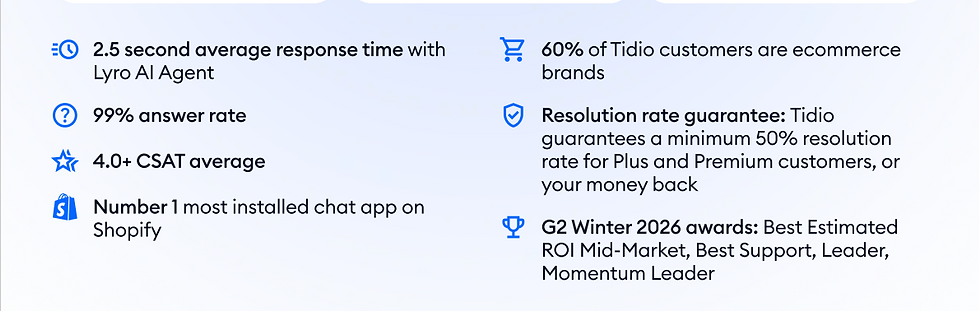
According to Tidio, Lyro resolves 67% of conversations on average, helping organizations automate repetitive customer interactions while allowing human teams to focus on more complex conversations.
Lyro can support businesses with:
Frequently asked questions
Product and service information
Customer onboarding
Policy explanations
Common troubleshooting
General support requests

The value of AI agents goes beyond answering questions.
The larger opportunity is creating a more efficient customer experience ecosystem:
Customers receive faster assistance.
Employees spend less time handling repetitive requests.
Organizations create more scalable support operations.
Tidio Product Overview, Current Pricing, and Platform Capabilities
PRICING
Free $0/mo. Starter $24.17/mo. Growth from $49.17/mo. Plus from $300/mo plus monthly usage. Premium, contact sales. Lyro AI Agent add-on from $32.50/mo.



Explore Tidio Through SUSTAINEVOLVE Marketplace & Innovation Lab

Organizations interested in exploring AI-powered customer engagement can learn more through the SUSTAINEVOLVE partner link.
(Affiliate disclosure: SUSTAINEVOLVE may receive compensation from qualifying referrals.)
AI Agent Applications Across Industries

Hospitality: Enhancing Guest Experience
Hospitality has always been centered around customer experience.
Hotels manage thousands of guest interactions involving:
Reservations
Check-in questions
Amenities
Policies
Restaurant information
Local recommendations
During high-demand periods, guest communication volumes can increase significantly.
AI agents can provide immediate support while allowing hospitality teams to focus on creating memorable experiences.
Banking and Financial Services
Financial institutions manage customer interactions where trust, accuracy, and security are essential.
AI agents can assist with:
General account information
Product questions
Digital banking guidance
Common customer requests
Human advisors remain essential for complex financial decisions, but AI can reduce repetitive workloads.
Telecommunications
Telecommunications companies manage high volumes of customer requests.
AI agents can support:
Billing questions
Service information
Device support
Common troubleshooting
This can help reduce pressure on customer service teams while improving response times.
Government Services
Citizens increasingly expect easier digital access to public services.
AI agents can help users navigate:
Applications
Forms
Requirements
Public information
This creates more accessible and efficient government experiences.
SUSTAINEVOLVE Perspective: Building Human-Centered AI Transformation
At SUSTAINEVOLVE, we believe successful AI transformation begins by identifying where customers experience friction and where employees spend valuable time on repetitive processes.
AI agents are not simply automation tools. They represent a new approach to intelligent operations.
Organizations that successfully adopt AI will combine:
Responsible AI practices
Human expertise
Strong operational processes
Customer-centered design
The future of customer experience will not be defined by technology replacing people.
It will be defined by technology helping people deliver better experiences.
Final Thoughts
The transition from chatbots to AI agents represents a major milestone in customer experience transformation.
Across hospitality, banking, telecommunications, government, and enterprise environments, organizations are searching for ways to improve service quality while managing increasing customer expectations.
Tidio’s Lyro AI Agent provides an example of how organizations can begin implementing conversational AI to reduce repetitive interactions and create more efficient customer engagement models.
The future of customer service is intelligent, scalable, and human-centered.
AI will not replace the importance of human connection.
It will help organizations create more meaningful interactions when human expertise matters most.
From AI Experimentation to Intelligent Transformation

The transition from chatbots to AI agents is only one part of a much larger transformation taking place across organizations.
The real opportunity is not simply to add an AI tool to an existing process.
It is to understand where technology, people, data, and operations intersect—and identify where intelligent systems can create measurable value.
Organizations preparing for the next phase of digital transformation should be asking:
Where are customers experiencing unnecessary friction?
Which repetitive processes could be intelligently automated?
Where are employees spending time on work that could be augmented by AI?
Are business systems connected well enough to support intelligent decision-making?
Where is revenue, productivity, or customer value being lost?
Which AI opportunities should be prioritized first?
How can AI be adopted responsibly while maintaining human oversight and trust?
These questions apply across industries—from hospitality and travel to financial services, telecommunications, government, professional services, and technology.
AI transformation is not simply about implementing artificial intelligence. It is about redesigning how organizations operate, serve customers, make decisions, and create value.
The SUSTAINEVOLVE Approach
At SUSTAINEVOLVE, we take a holistic approach to transformation.
We look beyond individual technologies and examine the broader ecosystem connecting:
People + Processes + Technology + Data + Customer Experience + Revenue + Operations + AI
The goal is to identify where these elements can work together more intelligently.
This may include opportunities in:
✓ AI strategy and transformation roadmaps
✓ Intelligent automation
✓ Customer experience transformation
✓ AI-enabled revenue operations
✓ Operational intelligence
✓ Systems and technology integration
✓ Process optimization
✓ Data and decision intelligence
✓ AI adoption and organizational readiness
✓ Human-centered AI implementation
Rather than recommending technology for technology's sake, SUSTAINEVOLVE focuses on identifying practical opportunities where AI and intelligent systems can solve meaningful business problems.
Ready to Explore Your AI Transformation Opportunities?
Whether you are beginning your AI journey or already experimenting with multiple AI technologies, the next step is understanding where the greatest opportunities exist within your organization.
A transformation assessment can help identify:
Where AI can create value
Where operational friction exists
Where automation can reduce repetitive work
Where customer experiences can be improved
Where disconnected systems are limiting performance
Where intelligent technology can support employees
And where your organization should prioritize its next transformation initiatives
Schedule a personalized consultation to explore your organization's AI transformation opportunities and identify practical areas for intelligent automation, customer experience improvement, operational intelligence, and AI adoption.
For organizations looking for a broader perspective, an AI transformation assessment can help evaluate the relationship between your technology ecosystem, business processes, customer experience, data, and operational priorities.
AI transformation should not begin with the question, “What AI tool should we buy?”
It should begin with:
“What problem are we trying to solve, and how can intelligent technology help us solve it better?”
SUSTAINEVOLVE helps organizations move from AI experimentation toward practical, responsible, and human-centered transformation.
About SUSTAINEVOLVE
Transforming Organizations Through Intelligent, Human-Centered Innovation

Esperanza Arellano, is the Founder & CEO at SUSTAINEVOLVE. She combines deep hospitality operations experience with nearly two decades of technology transformation leadership.
She has spent almost a decade working directly within hospitality revenue operations teams, helping organizations improve occupancy performance, revenue optimization, and operational effectiveness.
In addition, she brings more than 18 years of experience leading technology go-to-market, revenue operations, digital transformation, and AI adoption initiatives.
Her specialization focuses on helping organizations modernize operations through AI-enabled systems and integrated business processes.
Professional Credentials:
Her work focuses on helping organizations identify revenue leakage, eliminate system fragmentation, improve operational efficiency, and build practical AI transformation roadmaps.
Continue the Conversation
If your organization is exploring AI agents, intelligent automation, customer experience transformation, revenue intelligence, or broader digital transformation, SUSTAINEVOLVE can help you identify where to begin—and where technology can create the greatest strategic impact.
HAVE QUESTIONS?


Comments